Practise With Calculator計數機練習室

FMLA built-in formulas 內置公式

The FMLA key holds 23 ready-made formulas. These 16 are the ones in school syllabuses: HKDSE Mathematics and Physics, IB Mathematics and Physics, and UK GCSE and A-level. Each has what it asks for, a worked example and the screen it shows.

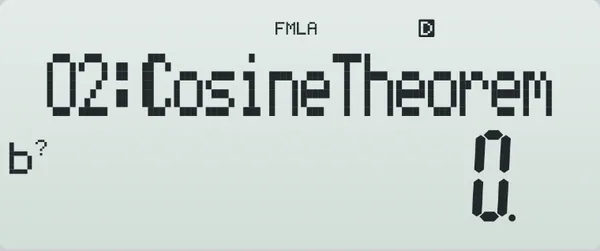
Sci-50 display after FMLA 0 2: 02:CosineTheorem, asking for b
FMLA 0 2 opens formula 02

The formulas

Mathematics: 5 formulas. Physics: 11 formulas.

Using a built-in formula

  1. Press FMLA. The display asks Formula No.?
  2. Type the two-digit number, for example 0 2. The formula's name appears on the upper line and the lower line asks for the first value. You can also press ▼ or ▲ to step through the names, then EXE.
  3. Type each value and press EXE. The lower line shows the letter it wants and the value used last time; EXE on its own keeps that value.
  4. The answer shows with its letter, such as a= 7. Press EXE to work it again with new values, or AC to leave.
  5. Angles are read in the unit set in SETUP. Check that D shows on the display before a formula with θ.

Not listed here: formulas 10 to 13 and 21 to 23 (voltage gain in decibels, impedance of LRC circuits, LC oscillation, Bernoulli's theorem and stadia surveying). They are beyond these school syllabuses.

FMLA 01

Quadratic Equation Solution

HKDSE MathsIB MathsGCSE & A-level Maths

Solves ax² + bx + c = 0 for the coefficients you give and shows both real roots.

x = (−b ± √(b² − 4ac)) ÷ 2a

LetterMeaningUnit
acoefficient of x²—
bcoefficient of x—
cconstant term—
x1first root—
x2second root (press EXE)—
Example
Solve 2x² − 3x − 5 = 0: a = 2, b = −3, c = −5.
Keys
FMLA 0 1 2 EXE (−) 3 EXE (−) 5 EXE
Screen shows
x1 = 2.5, then EXE: x2 = −1
Answer
The roots are 2.5 and −1.

Math ERROR means a = 0 or b² − 4ac < 0 (no real roots).
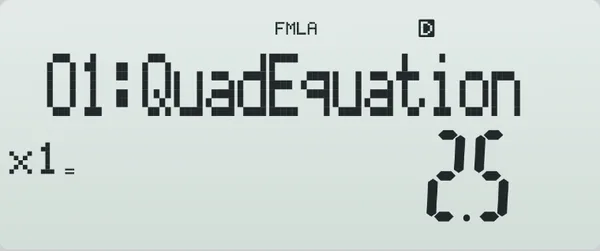
x2 = −1x1 = 2.5y = 2x² − 3x − 5 Sci-50 display: formula 01 result, x1 = 2.5The same formula after EXE: the second root x2 = −1
The example drawn, and the calculator's display with the answer.
FMLA 02

Cosine Theorem (cosine formula)

HKDSE MathsIB MathsGCSE Maths

Length of the third side of a triangle from two sides and the angle between them.

a = √(b² + c² − 2bc cos θ)

LetterMeaningUnit
bone sideany length unit
cthe other sidesame unit
θangle between b and cdegrees in Deg
athe third sidesame unit
Example
Two sides of 5 cm and 8 cm with 60° between them.
Keys
FMLA 0 2 5 EXE 8 EXE 60 EXE
Screen shows
a = 7
Answer
The third side is 7 cm.

θ is read in the angle unit set in SETUP: check that D shows for degrees.

θ = 60°c = 8b = 5a = 7 Sci-50 display: formula 02 result, a = 7
The example drawn, and the calculator's display with the answer.
FMLA 03

Heron’s Formula

HKDSE Maths

Area of a triangle from the lengths of its three sides.

S = √(s(s − a)(s − b)(s − c)), where s = (a + b + c) ÷ 2

LetterMeaningUnit
asideany length unit
bsidesame unit
csidesame unit
sarea Ssquare of the unit
Example
A triangle with sides 13 cm, 14 cm and 15 cm.
Keys
FMLA 0 3 13 EXE 14 EXE 15 EXE
Screen shows
s = 84
Answer
The area is 84 cm². The letter s on the display is the area S, not the half-perimeter.

Math ERROR means the three lengths cannot form a triangle.

Used in the IB-style question I4 →

141315S = 84 Sci-50 display: formula 03 result, s = 84
The example drawn, and the calculator's display with the answer.
FMLA 04

Normal Probability P(x)

HKDSE Maths M1IB MathsA-level Maths

Probability that a standard normal variable Z is at most x: the area under the bell curve from −∞ to x.

P(x) = P(Z ≤ x)

LetterMeaningUnit
xstandard score z—
Pprobability—
Example
Find P(Z < 1.96).
Keys
FMLA 0 4 1.96 EXE
Screen shows
P = 0.975002175
Answer
0.9750 to 4 decimal places, as in normal tables.

x must be 0 or more; for a negative z use P(Z < −z) = 1 − P(z). The calculator uses an approximation, so the last digits can differ from tables (exact 0.9750021).

x = 1.96P = 0.975 Sci-50 display: formula 04 result, P = 0.975002175
The example drawn, and the calculator's display with the answer.
FMLA 05

Normal Probability Q(x)

HKDSE Maths M1IB MathsA-level Maths

Probability that a standard normal variable lies between 0 and |x|: the area under the bell curve from 0 to |x|.

Q(x) = P(0 ≤ Z ≤ |x|)

LetterMeaningUnit
xstandard score z—
Qprobability—
Example
Find P(0 < Z < 1).
Keys
FMLA 0 5 1 EXE
Screen shows
Q = 0.34134474
Answer
0.3413 to 4 decimal places, so about 68% of values lie within one standard deviation of the mean.

Like P(x), it uses an approximation; the last digits can differ from tables.

x = 1QQ = 0.3413 Sci-50 display: formula 05 result, Q = 0.34134474
The example drawn, and the calculator's display with the answer.
FMLA 06

Coulomb’s Law

HKDSE PhysicsIB PhysicsA-level Physics

Force between two point charges Q and q a distance r apart.

F = Qq ÷ (4πε₀r²)

LetterMeaningUnit
Qfirst chargeC
qsecond chargeC
rseparationm
FforceN
Example
Two charges of 2.0 μC, 0.30 m apart.
Keys
FMLA 0 6 2 EXP (−) 6 EXE 2 EXP (−) 6 EXE 0.3 EXE
Screen shows
F = 0.399446746
Answer
The force is 0.40 N (repulsion, since both charges are positive).

Uses ε₀ = 8.854187817 × 10⁻¹² F/m. Type μC with EXP (−) 6.

++Q = 2 μCq = 2 μCFFr = 0.30 m Sci-50 display: formula 06 result, F = 0.399446746
The example drawn, and the calculator's display with the answer.
FMLA 07

Resistance of a Conductor

HKDSE PhysicsIB PhysicsA-level Physics

Resistance of a wire from the resistivity of its material, its length and its cross-sectional area.

R = ρℓ ÷ S

LetterMeaningUnit
ρresistivityΩ m
ℓlengthm
Scross-sectional aream²
RresistanceΩ
Example
A copper wire 50 m long with a cross-section of 1.0 mm² (1.0 × 10⁻⁶ m²); ρ = 1.7 × 10⁻⁸ Ω m.
Keys
FMLA 0 7 1.7 EXP (−) 8 EXE 50 EXE 1 EXP (−) 6 EXE
Screen shows
R = 0.85
Answer
The resistance is 0.85 Ω.

Convert mm² to m² first: 1 mm² = 1 × 10⁻⁶ m².

Sρℓ = 50 mcopper, ρ = 1.7 × 10⁻⁸ Ω m Sci-50 display: formula 07 result, R = 0.85
The example drawn, and the calculator's display with the answer.
FMLA 08

Magnetic Force on a Conductor

HKDSE PhysicsIB PhysicsA-level Physics

Force on a straight wire carrying current I in a uniform magnetic field B.

F = IBℓ sin θ

LetterMeaningUnit
IcurrentA
Bmagnetic flux densityT
ℓlength in the fieldm
θangle between wire and fielddegrees in Deg
FforceN
Example
5.0 A in 0.50 m of wire at 30° to a 0.20 T field.
Keys
FMLA 0 8 5 EXE 0.2 EXE 0.5 EXE 30 EXE
Screen shows
F = 0.25
Answer
The force is 0.25 N, at right angles to both the wire and the field.

θ is read in the angle unit set in SETUP: check that D shows for degrees.

BI = 5 Aθ = 30°F out of page Sci-50 display: formula 08 result, F = 0.25
The example drawn, and the calculator's display with the answer.
FMLA 09

RC Circuit Voltage

A-level Physics

Voltage across the resistor at time t after a voltage V is applied to a resistor and capacitor in series. The same expression gives a capacitor's voltage while it discharges.

V_R = V e^(−t ÷ CR)

LetterMeaningUnit
Vapplied (or starting) voltageV
CcapacitanceF
RresistanceΩ
ttimes
vvoltage V_RV
Example
12 V across 100 μF and 10 kΩ in series; find V_R after 1.0 s.
Keys
FMLA 0 9 12 EXE 100 EXP (−) 6 EXE 10 EXP 3 EXE 1 EXE
Screen shows
v = 4.414553294
Answer
4.41 V. Here CR = 1 s, so after one time constant the voltage has fallen to 12 ÷ e.

Type μF with EXP (−) 6 and kΩ with EXP 3.

4.41 V at t = 1 s12 Vt (s)V_R (V) Sci-50 display: formula 09 result, v = 4.414553294
The example drawn, and the calculator's display with the answer.
FMLA 14

Distance of Drop

HKDSE PhysicsIB PhysicsA-level Physics

Distance S an object falls in t seconds when thrown straight down at speed v₁, ignoring air resistance.

S = v₁t + ½gt²

LetterMeaningUnit
vstarting speed v₁ (0 if dropped)m/s
ttimes
sdistance fallen Sm
Example
A stone is thrown straight down at 5 m/s. How far does it fall in 2 s?
Keys
FMLA 1 4 5 EXE 2 EXE
Screen shows
s = 29.6133
Answer
29.6 m.

Uses g = 9.80665 m/s². With g = 9.81 the answer is 29.62 m; use the value your exam gives.

29.6 m at 2 st (s)S (m) Sci-50 display: formula 14 result, s = 29.6133
The example drawn, and the calculator's display with the answer.
FMLA 15

Simple Pendulum Period

IB PhysicsA-level Physics

Period T of a simple pendulum with a string of length ℓ (small swings).

T = 2π√(ℓ ÷ g)

LetterMeaningUnit
ℓstring lengthm
tperiod Ts
Example
A pendulum 1.00 m long.
Keys
FMLA 1 5 1 EXE
Screen shows
t = 2.006409293
Answer
The period is 2.01 s.

Uses g = 9.80665 m/s².

ℓ = 1 mT = 2.01 s Sci-50 display: formula 15 result, t = 2.006409293
The example drawn, and the calculator's display with the answer.
FMLA 16

Spring Pendulum Period

IB PhysicsA-level Physics

Period T of a mass m bouncing on a spring with spring constant k.

T = 2π√(m ÷ k)

LetterMeaningUnit
mmasskg
kspring constantN/m
tperiod Ts
Example
A 0.50 kg mass on a spring of 200 N/m.
Keys
FMLA 1 6 0.5 EXE 200 EXE
Screen shows
t = 0.314159265
Answer
The period is 0.314 s (exactly π ÷ 10).
k = 200 N/mm0.5 kgT = 0.314 s Sci-50 display: formula 16 result, t = 0.314159265
The example drawn, and the calculator's display with the answer.
FMLA 17

Doppler Effect

IB Physics

Frequency heard when the source of a sound, the listener or both are moving.

f = f₁(v − u) ÷ (v − v₁)

LetterMeaningUnit
ffrequency f₁ the source sendsHz
vspeed of soundm/s
ulistener's speed away from the sourcem/s
v1source's speed towards the listenerm/s
ffrequency heardHz
Example
A 700 Hz siren comes towards a standing listener at 20 m/s; sound travels at 340 m/s.
Keys
FMLA 1 7 700 EXE 340 EXE 0 EXE 20 EXE
Screen shows
f = 743.75
Answer
The listener hears 743.75 Hz, higher than 700 Hz.

Signs: u is positive when the listener moves away from the source, v₁ positive when the source moves towards the listener. Use negative values for the other directions.

source moves at 20 m/s →listener743.75 Hzsends f₁ = 700 Hz Sci-50 display: formula 17 result, f = 743.75
The example drawn, and the calculator's display with the answer.
FMLA 18

Ideal Gas Equation

HKDSE PhysicsIB PhysicsA-level Physics

Pressure of an ideal gas from the amount of gas, its absolute temperature and its volume.

P = nRT ÷ V

LetterMeaningUnit
namount of gasmol
TtemperatureK
Vvolumem³
PpressurePa
Example
1.00 mol of gas at 273.15 K in 0.0224 m³ (22.4 litres).
Keys
FMLA 1 8 1 EXE 273.15 EXE 0.0224 EXE
Screen shows
P = 101388.3048
Answer
About 1.01 × 10⁵ Pa, close to atmospheric pressure.

Temperature must be in kelvin and volume in m³. Uses R = 8.314472 J mol⁻¹ K⁻¹; with R = 8.31 the answer is 1.013 × 10⁵ Pa.

Pn = 1 mol, T = 273.15 KV = 0.0224 m³ Sci-50 display: formula 18 result, P = 101388.3048
The example drawn, and the calculator's display with the answer.
FMLA 19

Centripetal Force

HKDSE PhysicsIB PhysicsA-level Physics

Force needed to keep a mass m moving at speed v on a circle of radius r. The calculator names it Centrifugal; in school physics it is the centripetal force.

F = mv² ÷ r

LetterMeaningUnit
mmasskg
vspeedm/s
rradiusm
FforceN
Example
A 1200 kg car takes a bend of radius 50 m at 15 m/s.
Keys
FMLA 1 9 1200 EXE 15 EXE 50 EXE
Screen shows
F = 5400
Answer
The car needs 5400 N towards the centre of the bend.
r = 50 mv = 15 m/sFm = 1200 kg Sci-50 display: formula 19 result, F = 5400
The example drawn, and the calculator's display with the answer.
FMLA 20

Elastic Energy

IB PhysicsA-level Physics

Energy stored in a spring with spring constant K stretched (or squashed) by x.

U = ½Kx²

LetterMeaningUnit
Kspring constantN/m
xextensionm
uelastic energy UJ
Example
A 200 N/m spring stretched by 5.0 cm (0.05 m).
Keys
FMLA 2 0 200 EXE 0.05 EXE
Screen shows
u = 0.25
Answer
0.25 J, the area under the force–extension graph.

Convert cm to m first.

F = 10 N at x = 0.05 mU = 0.25 Jx (m)F (N) Sci-50 display: formula 20 result, u = 0.25
The example drawn, and the calculator's display with the answer.